


Qucik Answer
A fraud score is a numeric or categorical indicator of the risk associated with a transaction, account, session, or action. In many systems, a higher score indicates greater risk. However, the scale, direction, probability mapping, and recommended response vary by provider and scoring model.
A fraud score is not proof that fraud occurred. Treat it as one decision input: before approving, reviewing, or declining an activity, confirm what was scored, how the score is defined, which signals contributed to it, and where your organization’s thresholds are set.
What a fraud score means
A fraud score condenses multiple risk signals into a single indicator that is easier to use in automated rules and operational workflows. Depending on the system, it may evaluate:
- A payment or order
- An account registration or login
- A user session
- A withdrawal, transfer, or refund
- A profile change or other sensitive action
The scoring logic may use fixed rules, statistical models, machine learning, or a combination of methods. For example, a system might consider payment details, account history, device intelligence, IP information, behavioral patterns, and the frequency of recent activity.
The result expresses what that particular system considers risky. It does not independently establish that the user acted maliciously or that a transaction is fraudulent. A high score can reflect unusual but legitimate behavior, while a low score cannot guarantee that an activity is safe.

Fraud score vs. related risk indicators
Terms such as fraud score, risk score, IP reputation score, and proxy detection are sometimes used interchangeably, but they do not necessarily describe the same assessment.
| Indicator | What it evaluates | Typical scope | What it can support | What it cannot establish |
|---|---|---|---|---|
| Fraud score | Estimated likelihood or relative risk of fraudulent activity | Transaction, account, session, or action | Approval, verification, review, monitoring, or rejection decisions | That fraud definitely occurred |
| General risk score | Risk as defined for a particular business process | May cover fraud, compliance, credit, security, account abuse, or another risk category | Prioritization and policy-based decisions | A specific meaning unless the risk category and methodology are known |
| IP reputation score | Risk associated with an IP address or related network history | Network connection | Identifying suspicious infrastructure or adding context to a broader assessment | The identity or intent of the user, or whether a transaction is fraudulent |
| Proxy detection result | Whether a connection appears to use a proxy, VPN, relay, or similar technology | Connection or session | Triggering additional checks or contributing to a risk model | That the user is malicious or attempting fraud |
Fraud score
A fraud score can combine payment, identity, account, device, behavioral, historical, and network signals. Its scope is usually broader than any individual indicator included in the assessment.
It may also be designed for a specific action. For example, a model designed to assess card payments may not interpret account logins or profile changes in the same way.
General risk score
A risk score is a broader concept. It may represent transaction risk, security risk, credit risk, compliance risk, account-takeover risk, or another defined category.
Before acting on a risk score, determine which risk is being measured. A score designed to identify suspicious logins should not automatically be interpreted as a payment fraud probability.
IP reputation score
An IP reputation score shows the level of risk associated with an IP address based on its network characteristics or past activity. It can provide useful context, but it cannot determine whether a user or transaction is fraudulent on its own.
When reviewing IP reputation, consider it alongside other signals, such as account history, device consistency, payment details, and verification results.
For compliant workflows that require a consistent network environment, such as regional website testing, ad verification, market research, or account operations, IP quality and connection continuity matter alongside IP reputation signals. FlashIP provides clean, stable proxy IPs across 195+ countries and regions, helping teams build a more consistent network environment based on their target market and workflow.
Example: Checking the Reputation of a FlashIP U.S. IP Address
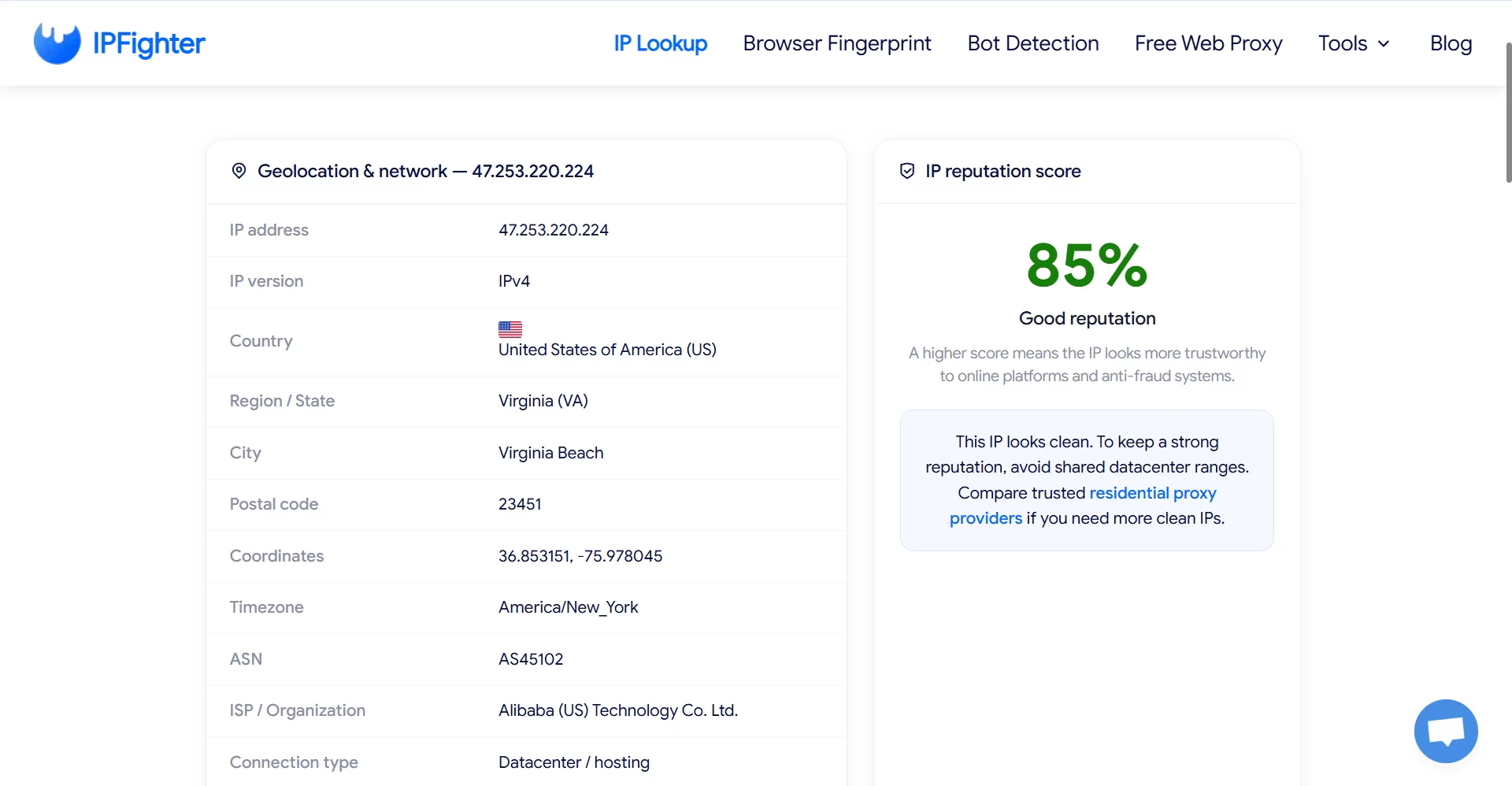
At the time of testing, the tool did not flag the IP for known proxy, VPN, blacklist, or abuse-related risks.
Proxy detection result
Proxy detection is usually a finding or signal rather than a complete fraud judgment. It indicates something about how a connection appears to reach your service.
Legitimate users may use corporate networks, privacy tools, VPNs, or shared connections. A proxy result can justify additional scrutiny, but it should not be treated as standalone proof of abuse.
For a closer look at proxy status, IP reputation, blacklist records, location accuracy, and connection stability, see FlashIP’s guide: How to Check a Proxy IP Quality: 5 Key Signs of a Clean IP.
How to read a fraud score correctly
Before acting on a fraud score, check five things:
- Who produced the score?
- What was scored: a transaction, account, device, or session?
- What is the score range, and does a higher or lower score mean more risk?
- Is it a relative risk score or an estimated probability?
- What actions does your organization take at each risk level?
A score of 30, 70, or 900 has no universal meaning. Different systems use different scales, models, and thresholds. Always follow the provider’s documentation and your own risk policy.
Relative risk is not the same as fraud probability
A higher score usually means the activity appears riskier within that system. It does not automatically mean the score is a percentage or that fraud is certain.
Unless the provider clearly defines the score as a validated probability, treat it as a risk ranking or risk band—not a direct prediction of fraud.
Fraud scores are usually based on a mix of signals, such as payment details, account history, device and IP information, user behavior, and recent activity. No single signal proves fraud. A new device, an unusual login location, or a proxy connection may be legitimate on its own, but several unusual signals appearing together may require additional checks.
How to turn a score into a decision
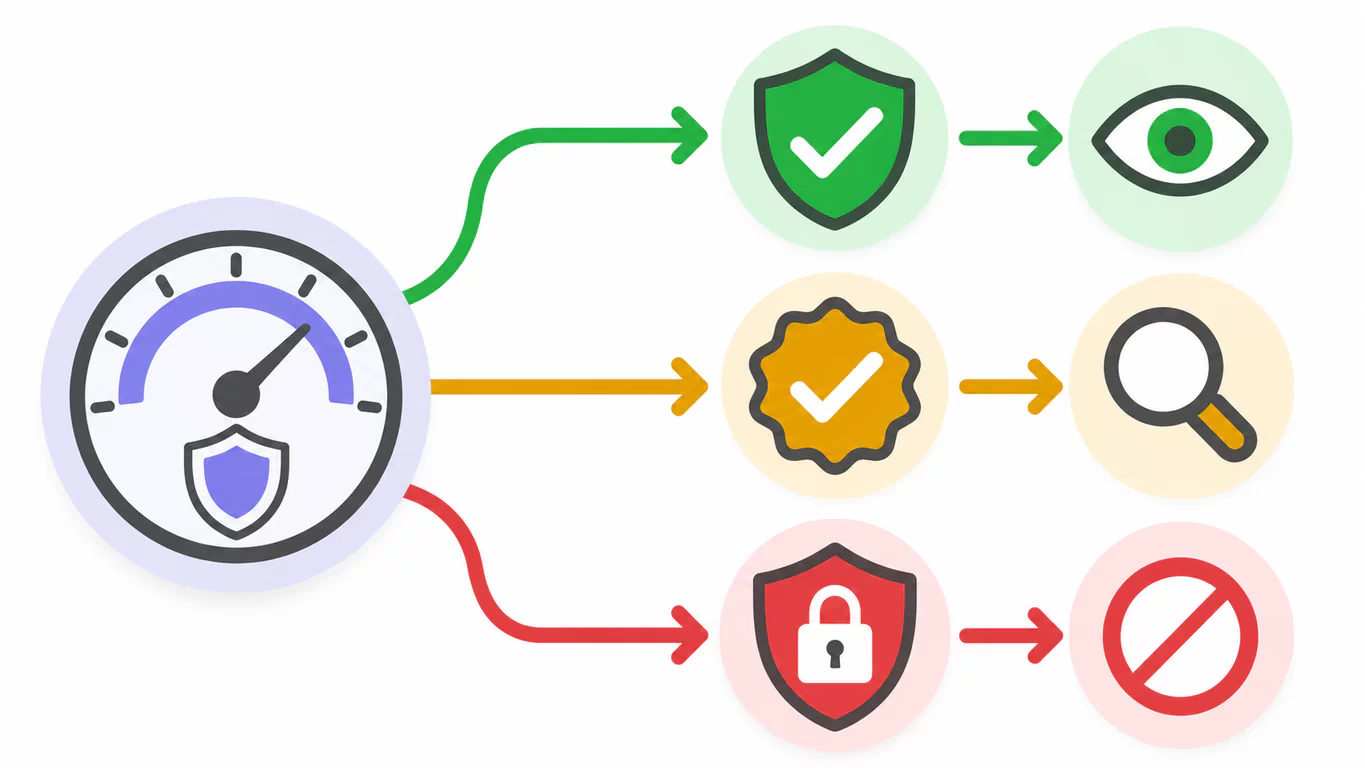
A useful decision policy connects score ranges to proportionate responses. Those responses can include:
- Automatic approval
- Approval with monitoring
- Step-up verification
- Manual review
- Temporary restriction
- Rejection or decline
The appropriate threshold depends on more than the score. Consider transaction value, customer context, available verification methods, review capacity, expected fraud losses, customer friction, and your organization’s risk tolerance.
Low-risk range: approve or monitor
Activities in a validated low-risk band may be approved automatically or monitored without adding customer friction. However, low risk does not mean zero risk.
Track outcomes for the band so you can identify changes in fraud patterns or score behavior. If losses begin to concentrate in a range previously considered safe, the threshold or underlying model may need attention.
Middle range: verify or review
The middle range is often where additional context has the most decision value. Possible responses include:
- Requesting step-up authentication
- Confirming contact or identity information
- Reviewing transaction and account history
- Checking whether the device is familiar
- Comparing shipping, billing, and payment details
- Holding a high-value action for manual review
- Monitoring the account after approval
The goal is not to eliminate every uncertainty. It is to obtain enough additional information to make a proportionate decision without sending every ambiguous event to an analyst.
High-risk range: restrict or decline
A high-risk score may justify a decline, temporary restriction, or escalated review when it aligns with your policy and surrounding context. The decision should reflect the cost of allowing fraud as well as the cost of blocking a legitimate customer.
An automatic decline may be appropriate for some combinations of score, value, and confirmed policy violations. In other cases, step-up verification or manual review may be preferable, particularly when the activity is high value or the false-positive cost is substantial.
Balance false positives and false negatives
Thresholds create trade-offs:
- A false positive occurs when legitimate activity is classified or handled as suspicious.
- A false negative occurs when fraudulent activity passes through as acceptable.
Lowering a rejection or review threshold may capture more suspicious activity, but it can also increase customer friction and review volume. Raising the threshold can reduce interventions while allowing more risky activity through.
Evaluate outcomes separately for each decision band. Useful measures may include confirmed fraud outcomes, legitimate approval rates, review volume, verification completion, customer abandonment, and operational handling time. Revisit thresholds when business conditions, customer behavior, fraud patterns, or the score’s distribution changes.
A five-step checklist for investigating a score
- Identify the scoring system and scored object. Confirm which provider, model, or internal rule set produced the result. Determine whether it evaluated a payment, order, account, session, device, login, or another action.
- Verify the score definition. Check the scale, direction, risk bands, threshold settings, and whether the number is a relative ranking or an explicitly defined probability.
- Inspect contributing signals. Review the rules, reason codes, model explanations, or notable inputs associated with the result. Do not rely on the final number alone.
- Compare the signals with broader context. Examine transaction value, account history, customer behavior, device continuity, payment details, network context, and recent operational events. Look for combinations of signals rather than assuming one anomaly establishes fraud.
- Choose and record a proportionate response. Approve, monitor, verify, review, restrict, or reject according to your policy and the available context. Record the eventual outcome so you can evaluate the decision band and adjust thresholds based on measured results.
Need proxy options for regional testing, market research, or ongoing online operations?
Explore FlashIP Proxy Solutions
The practical meaning of a fraud score comes from its definition and how it performs within your decision process—not from the number in isolation.
FAQ
What Is a Good Fraud Score?
There is no universal “good” fraud score. A lower score is often considered lower risk, but the meaning depends on the provider’s scale, model, and thresholds. Always use the risk bands configured for your own system rather than comparing scores across different platforms.
How Is a Fraud Score Calculated?
Fraud scores are calculated differently across systems. Common inputs include payment details, account history, device and IP information, location, user behavior, and recent activity. Some systems use rules, while others use machine learning models or a combination of both.
How Can You Check an IP Fraud Score or IP Reputation?
Use an IP quality or reputation-checking tool to review the IP’s risk score, proxy status, network type, location, and blacklist records. Results can vary between providers, so use them as context rather than a final judgment.
For legitimate regional testing, ad verification, market research, and online operations, FlashIP offers residential, mobile, ISP, and datacenter proxy options across 195+ countries and regions. Teams can validate a connection before use to confirm that it fits their workflow.
Can a Proxy Affect an IP Fraud Score?
A proxy may be one signal considered in an IP or fraud risk assessment, but using a proxy does not automatically mean the activity is fraudulent. Risk systems may also consider the IP’s reputation, location consistency, account history, device information, and user behavior.
What Is the Difference Between a Fraud Score and a Credit Score?
A fraud score estimates the potential risk of fraudulent activity, such as payment fraud or account abuse. A credit score estimates a person’s or business’s creditworthiness, usually based on borrowing and repayment history. They serve different purposes and should not be interpreted in the same way.
Can a Fraud Score Change Over Time?
Yes. A fraud score can change as new activity, account history, payment information, device data, or network signals become available. The same user or transaction may receive a different score at a different time.
Are Fraud Scores Always Accurate?
No. Fraud scores are risk estimates, not final judgments. They can produce false positives, where legitimate activity is flagged, and false negatives, where fraudulent activity is not detected. Regularly reviewing outcomes helps improve decision rules over time.