

Key Takeaways
E-commerce businesses often work across different markets, platforms, and online environments. Proxies can help when website content changes by location, multiple store accounts need separate network setups, or public product and campaign information needs to be checked across regions.
-
Check localized storefronts: Review regional prices, currencies, promotions, shipping options, and product availability from target locations.
-
Manage multiple store environments: Use separate browser profiles and proxy connections to keep account sessions and network settings easier to organize.
-
Monitor prices and market data: Compare public product information across markets and track changes in pricing, promotions, availability, and listings.
-
Verify regional ads and promotions: Check how ads, landing pages, and promotional content appear to users in different locations.
Choosing the right proxy depends on the workflow. Residential proxies are commonly used for location-based checks, while static ISP, mobile, and datacenter proxies can support more specific access, testing, and data collection needs.
4 Practical Ecommerce Proxy Use Cases for Online Businesses
E-commerce businesses often work across different markets, platforms, and regional websites. Proxies can support these workflows when content changes by location, when public data needs to be checked repeatedly, or when a more consistent network setup is required.
Verifying Localized Storefronts Across Different Markets
Storefront content can vary by location. Customers in different countries or regions may see different currencies, prices, promotions, shipping options, landing pages, and product availability.
Regional proxies allow e-commerce teams to access storefronts from target locations and verify whether localized content is displayed as intended. They can also support local market research by helping teams review regional product listings, offers, and customer-facing content.
Residential proxy services can offer country-, state-, and city-level targeting, along with rotating and sticky sessions. Available locations and session options depend on the provider and plan.
IP location is only one factor in storefront localization. Browser language, cookies, account preferences, device settings, and website configuration can also influence what users see.
Managing Multiple Stores and Account Environments
Managing multiple store accounts on the same platform can become difficult as the number of accounts grows. Teams may need to switch between logins frequently, while keeping cookies, sessions, and network settings separate for each store. Using the same browser environment for every account can make these workflows harder to organize.
Separate browser profiles can help keep each store environment independent, while proxies let teams assign a separate network configuration to each profile. Static ISP proxies are useful when a store requires a more consistent IP for recurring access and longer sessions.
FlashIP can be configured directly in standard browsers, anti-detect browsers, and automation tools without complex deployment. For multi-account workflows that benefit from a consistent connection, static ISP proxies can provide a stable IP for recurring access and longer sessions.
For more information on proxy options for multi-account workflows, read Residential Proxy vs. Mobile Proxy: Which Is Better for Multi-Account Teams?

Competitor Price Monitoring and Market Data Analysis
Product prices, discounts, shipping information, and stock availability can vary across markets and change frequently during promotional periods. For e-commerce businesses tracking multiple competitors or regions, checking these changes manually can quickly become time-consuming.
Regional proxies can support repeated access to public product pages from different locations, making it easier to compare market-specific information such as:
-
Listed prices and discounts
-
Product availability and stock status
-
Shipping options
-
Regional promotions
-
Changes to product listings
This is especially useful when the same product is priced or presented differently across countries.
| Market | Listed Price | Currency | Official Source |
|---|---|---|---|
| United States | $929 | USD | Apple US |
| United Kingdom | £899 | GBP | Apple UK |
| Germany | €1,099 | EUR | Apple Germany |
iPhone 17 (256GB) listed prices checked on October 14, 2026. The US example uses “Connect on your own later.” Prices are shown in local currencies without exchange-rate conversion; tax treatment and carrier offers differ. Check each official store for current purchase terms.
Residential proxies are commonly used when monitoring depends on location, while datacenter proxies may be suitable for higher-volume public data collection.
For more details, see E-Commerce Price Monitoring with FlashIP.
Verifying Region-Specific Ads and Promotions
E-commerce businesses often run different ads, offers, and landing pages for different markets. However, teams outside the target region may not always see the same campaign experience as local users.
Regional proxies can help teams review public-facing ads and promotional pages from target locations. This can be useful for checking whether the correct regional offer is displayed, landing pages redirect as expected, local prices and currencies are shown correctly, and promotional content matches the target market.
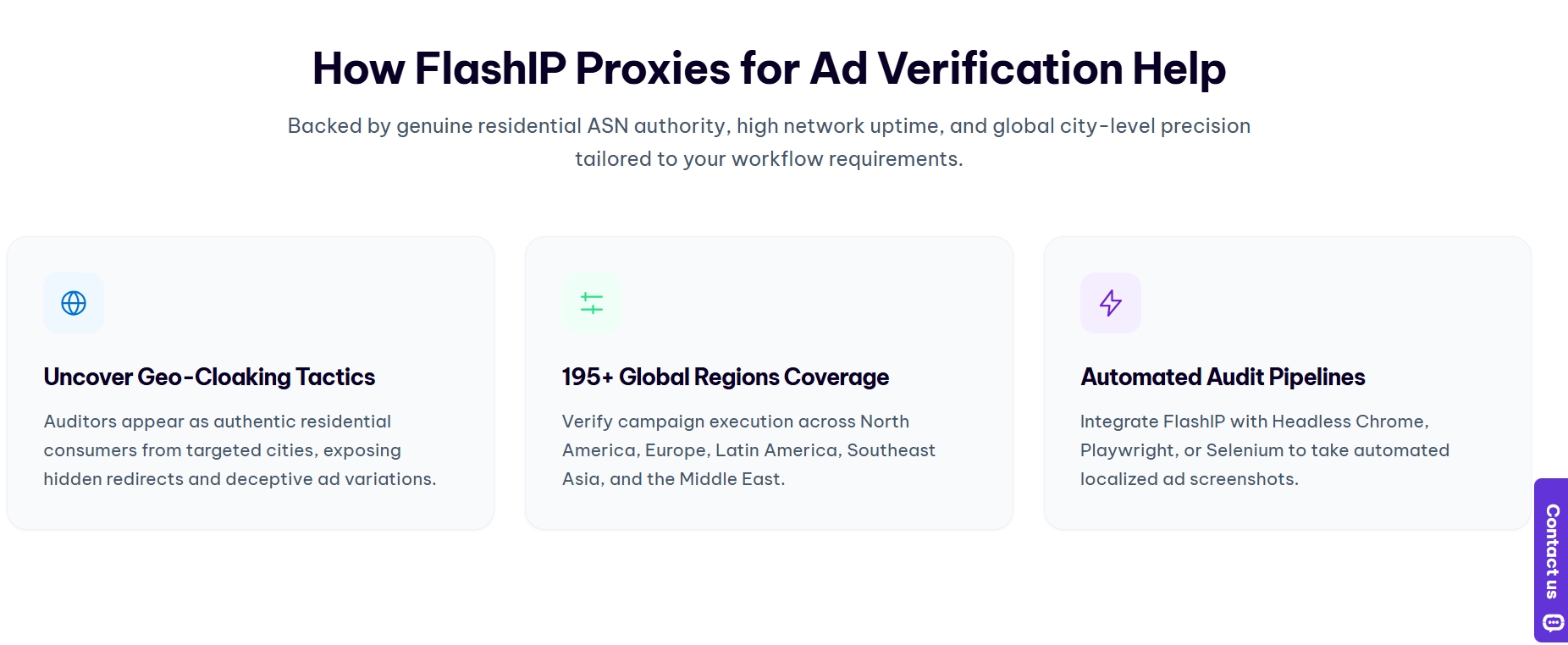
These checks can help identify localization or display issues after a campaign goes live and provide additional context when reviewing competitor promotions across different markets. Proxy-based verification should be used alongside advertising platform data and campaign analytics rather than as a replacement for them.
How to Choose the Right Ecommerce Proxy for Your Business
The right proxy type depends on what the business needs to access, how often the task is repeated, and whether the workflow requires a stable or changing IP address.
Residential proxies are generally suitable for tasks where location matters, such as regional storefront checks, market research, price monitoring, and ad verification. Static ISP proxies are more appropriate for recurring account access or longer sessions that benefit from a consistent IP. Mobile proxies can support mobile-specific testing, while datacenter proxies are often used for higher-volume public data collection or routine automation.
| Main Business Need | Recommended Proxy Type |
|---|---|
| Market research, price monitoring, regional storefront checks | Residential Proxies |
| Store management, recurring account access, long sessions | Static ISP Proxies |
| Mobile storefront or campaign testing | Mobile Proxies |
| Large-scale routine monitoring or permitted automation | Datacenter Proxies |
Businesses do not necessarily need to use every proxy type. In many cases, one option can support several related workflows, with additional proxy types added only when the requirements change.
FlashIP offers residential, static ISP, mobile, and datacenter proxies, with global location coverage. Its proxy connections can be configured in browsers, anti-detect browsers, and automation tools, allowing teams to integrate them into existing e-commerce workflows without complex deployment.
Explore FlashIP Proxy Solutions
Conclusion
Ecommerce proxies can be useful when businesses need to work across different markets, check location-specific content, monitor public product data, or maintain a more consistent network setup for recurring tasks.
There is no single proxy type that fits every workflow. Residential proxies are better suited to location-based checks and research, while static ISP, mobile, and datacenter proxies can support more specific needs such as longer sessions, mobile testing, or larger-scale data collection.
For most e-commerce teams, it makes more sense to start with the main use case, choose the proxy type that fits it, and expand the setup only when new needs come up.
FAQ
What is an ecommerce proxy?
An ecommerce proxy routes internet requests through another IP address. Businesses commonly use proxies for regional storefront checks, market research, price monitoring, and recurring account access. The right proxy type depends on whether the task requires location coverage, IP rotation, or a stable connection.
Can an ecommerce proxy prevent account bans?
No. A proxy only changes the network connection used to access a website. Account status can also depend on platform policies, verification requirements, user permissions, account history, and operating behavior.
What should I do if my Amazon seller account is deactivated?
First, check the reason shown in Amazon Seller Central under Account Health. Amazon allows sellers to request reactivation by selecting Reactivate your account and following the required appeal steps, which may include providing supporting documents, acknowledging a violation, or explaining why the deactivation was made in error.
For a more detailed breakdown of possible causes and recovery steps, see Amazon Account Suspended? Your Guide to Recovery and Prevention.
Can I use one ecommerce proxy for different countries?
Yes, depending on the proxy type and provider. Residential proxy services often let users select IP locations across multiple countries, and some also support state- or city-level targeting. This can be useful for checking regional storefronts, pricing, promotions, or other location-specific content.
What should e-commerce businesses look for when choosing a proxy provider?
E-commerce businesses should consider connection stability, location coverage, proxy type, session options, and whether the service can fit into existing workflows. These factors matter for tasks such as store access, regional research, price monitoring, and product availability tracking.
FlashIP delivers stable, flexible proxy connectivity that makes it easy to access websites in different regions, collect public data, and view local market information—so access failures and connection drops don’t get in the way of day-to-day business.